
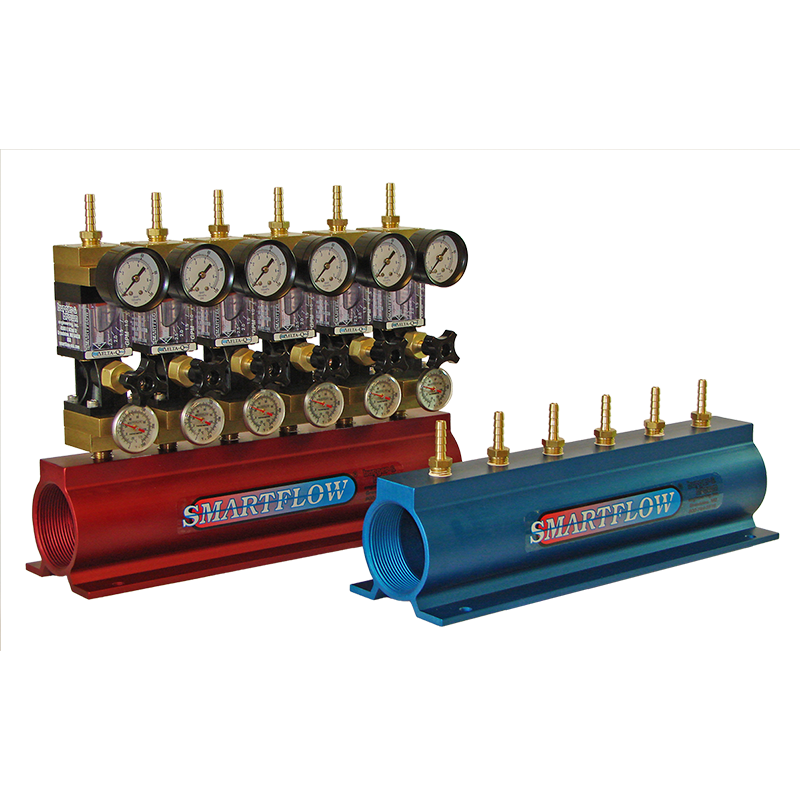
Why should you use flow regulators in your injection mold cooling circuits?
Cooling water flows along the path of least resistance. Cooling channels with the largest diameter will naturally allow the most flow to pass through.
Assuming you have an injection mold with several 1/4″ diameter lines and one smaller bubbler path fed by a manifold. The bubbler path needs a small amount of cooling water to cool a critical feature of the part.
Your 1/4″ lines are flowing along well, but how do you know if the bubbler is seeing any flow at all?
A certain amount of water is available to the mold cooling through the supply manifold. This flow needs to spread through all cooling lines, providing balanced cooling and ensuring that flow is also available to the bubbler.
By placing flow regulators on the Return side of the cooling water loop, you can adjust the flow rate to each cooling circuit, balance turbulent flow, and verify that even your smallest bubbler line is flowing.
So why place the regulators on the Return side instead of the Supply side?
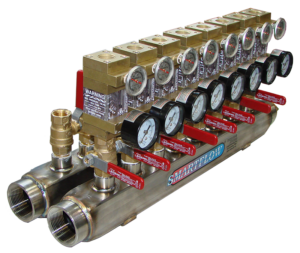
Regulators on the Return side place the restrictions after the water goes through the mold. The cooling passages are full of cooling water instead of trickling through. This means that all inside surfaces are in contact with the cooling water, giving you the best opportunity to cool the molten plastic successfully before part ejection.